Live Poker Strategy: 101 Players on Big Opens and Straddles
What 101 live players ask an AI coach. In their hands, 76% of opens were over 3.5BB, 55% went multiway and 78% were over 100BB deep. Plus SPR and straddle tips.
Plenty of players do well online, then sit down at a live table and something feels off. Opens of 8BB or 10BB are routine, flops regularly go four or five ways, stacks are deep, and the ranges you studied online don't seem to apply.
This article uses DEEPFOLD's data to answer two questions about live poker strategy: when live players ask the AI coach for help, what are they actually asking? And how do the live hands they describe differ from online games? The goal is live poker tips grounded in the spots players really run into.
About the data: from February to October 2026, 494 players asked the DEEPFOLD AI coach real strategy questions. 101 of them (20%) asked about live games (casinos, card clubs, home games), in 708 messages. All figures are anonymized aggregates, and rankings show the share of players who asked about each topic.
Key takeaways
- 1 in 5 players who ask strategy questions have asked about live poker: 101 out of 494, and two-thirds of them asked about cash games.
- The most common question is how to play live hands postflop (44%), followed by how to play against and exploit live players (27%).
- Live questions cover very different ground: they mention multiway pots more than 3x as often as other questions and deep stacks nearly 5x as often, while push/fold, big blind defense and solvers come up less.
- The live hands players describe usually have big opens: among hands where the open size was stated, 76% were opened to 4BB or more, and a third to 7BB or more.
- Multiway pots and deep stacks are the norm: 55% of hands saw a flop with 3 or more players, and 78% had stacks over 100BB. Big opens plus multiple callers make the SPR drop fast.
What live players ask the AI coach
We classified all 708 live-game questions by what each one was mainly about. Here is the share of the 101 players who asked about each topic:
| Rank | Question type | Players who asked |
|---|---|---|
| 1 | Postflop play in live hands | 44% |
| 2 | How to play against and exploit live players | 27% |
| 3 | Live tournaments | 26% |
| 4 | Stakes, bankroll, results, rake | 22% |
| 5 | Mindset, nerves, tilt | 18% |
| 6 | Preflop play in live hands | 17% |
| 7 | Multiway pots | 13% |
| 8 | Reads, tells, opponents' habits | 12% |
| 9 | Facing very large opens | 9% |
| 10 | Deep stacks | 9% |
| 11 | How big to open | 9% |
| 12 | Pots with lots of limpers | 8% |
| 13 | Rules and etiquette | 7% |
| 14 | Straddle | 4% |
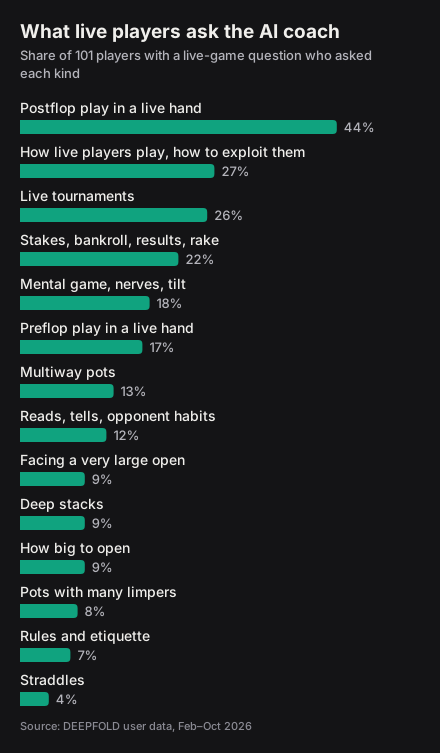
A few things stand out:
- Specific hands are the most common question. Live games don't produce hand histories, so players describe the blinds, the stacks and the action on each street in their own words, then ask the AI whether they played it right. Within these hand reviews, 35% were about a river decision.
- 27% of players asked about the live player pool. Typical descriptions: opponents are sticky preflop and rarely fold, river check-raises are almost always the nuts, and checking invites someone to steal. What players want to know is how far to deviate when opponents clearly aren't playing GTO.
- 22% asked about stakes, bankroll and rake. Live games deal far fewer hands per hour and take a bigger share in rake, so many players are working out whether their win rate is actually good enough.
For the basic differences between online and live play, start with "From Online to Live Poker: Essential Adjustments for the Felt".
What live questions bring up more than other questions
A single question can touch on several topics. Comparing the 708 live-game questions with 11,762 other strategy questions, here is how often each topic was mentioned:
| Topic | Live-game questions | Other questions |
|---|---|---|
| Exploitative play | 23% | 13% |
| Multiway pots | 14% | 4% |
| Deep stacks | 12% | 3% |
| Limping and iso-raising | 9% | 3% |
| GTO and solvers | 4% | 5% |
| Big blind defense | 3% | 9% |
| Push/fold | 2% | 7% |
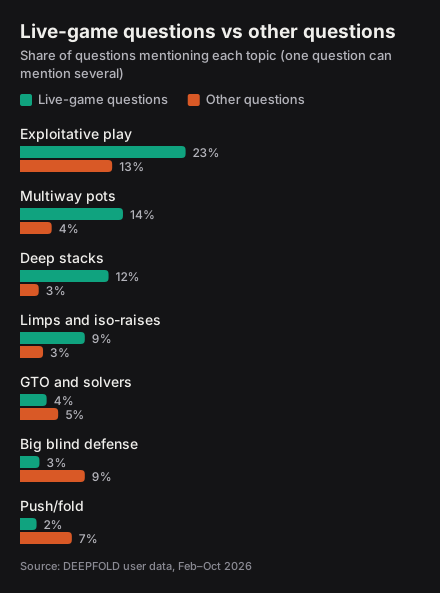
The differences are clear:
- Multiway pots, deep stacks and limping come up far more in live games: more than 3x, nearly 5x and nearly 3x as often. None of these are common in standard online games, so this is exactly where online habits are most likely to break down.
- Exploitative play shows up nearly 2x as often. Live player pools stray much further from GTO, and players are more eager to adjust to specific opponents.
- Push/fold and big blind defense come up much less. With deep stacks and big opens, live players rarely get short enough to push or fold, and a big blind facing an 8BB open doesn't need to defend nearly as much as one facing a 2.5BB open online.
(Even after excluding the 5 most active players, the shares for multiway pots and deep stacks stay just as high.)
How big live opens really are
54 players stated the open size when describing a hand, across 242 hands. Converting each open into big blinds:
| Open size | Share of hands |
|---|---|
| 2-3.5BB | 24% |
| 4-6.5BB | 44% |
| 7-10BB | 16% |
| Over 10BB | 17% |
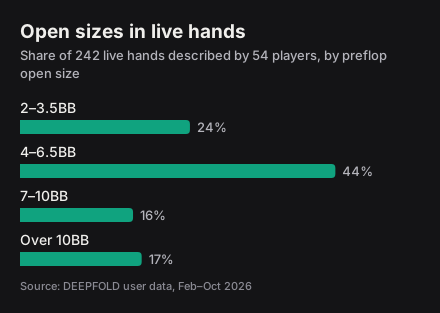
(Percentages are rounded and may not add up to exactly 100%.)
A standard online open is about 2-3BB, but in the live hands players described, that size made up only a quarter. 76% of hands were opened to 4BB or more, and a third to 7BB or more. By player, 72% described at least one hand opened to 4BB or more, and 39% described at least one opened to 7BB or more.
This is where a lot of live players' questions start. One player wrote that the table was nominally 250BB deep, but with everyone opening to 10BB it played more like 50BB.
Multiway pots and deep stacks are the norm
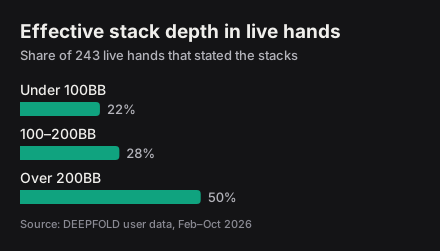
Looking at the same live hands, here is how many players saw the flop and how deep the stacks were:
| Players to the flop | Share of hands |
|---|---|
| 2 players | 45% |
| 3 players | 27% |
| 4+ players | 27% |
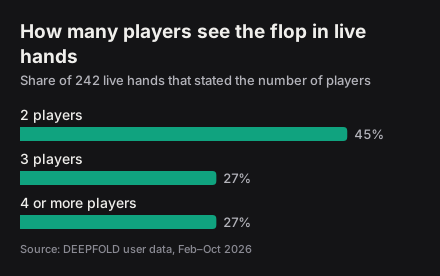
| Effective stack | Share of hands |
|---|---|
| Under 100BB | 22% |
| 100-200BB | 28% |
| Over 200BB | 50% |
(Percentages are rounded and may not add up to exactly 100%.)
55% of hands saw a flop with 3 or more players, and among players who stated the number of players, 66% described at least one multiway pot. Half of all hands had stacks over 200BB.
Keep in mind that these are hands players chose to ask about, not a random sample of every hand they played. Players tend to bring up complicated, big pots, so the real-world shares are probably lower. But the direction is clear: live games are deeper and more multiway than online games.
Big opens plus multiple callers: how fast SPR drops
SPR (stack-to-pot ratio) is the stack left behind on the flop divided by the size of the pot. The lower the SPR, the easier it is to get all in with one pair. The higher the SPR, the stronger your hand needs to be to play for stacks.
Here is the flop SPR at 200BB effective, with both blinds folding, for different open sizes and numbers of callers:
| Open size | Heads-up (1 caller) | 4-way pot (3 callers) |
|---|---|---|
| 2.5BB | 30.4 | 17.2 |
| 5BB | 17.0 | 9.1 |
| 8BB | 11.0 | 5.7 |
| 12BB | 7.4 | 3.8 |
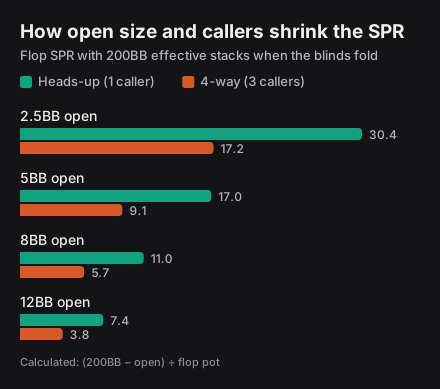
With 200BB stacks, a 12BB open and 3 callers, the flop SPR is only 3.8. At that point top pair is very hard to fold, and the pot is big enough that one or two bets get the money in. Nominally deep stacks end up playing like short stacks.
This table points to three adjustments:
- Go by SPR, not nominal stack depth. Look at how big the open is and how many players called before you decide how to play the hand, instead of just noticing that you have 200BB.
- Speculative hands depend on the open size. Small pairs and suited connectors make their money by winning big pots after the flop. The bigger the open, the more you pay to see a flop and the less you can win back relative to that price. A common rule of thumb: to call for set value, the call should be no more than 1/15 to 1/20 of the smaller remaining stack.
- With strong hands against a big open, 3-betting beats calling. Calling invites more players in, while a 3-bet can turn the pot heads-up. And because the open is already large, the SPR after a 3-bet is usually low enough that you can comfortably get it all in.
For multiway play, see "Multiway Pot Strategy". For deep-stack play, see "Deep Stack Poker".
How to adjust to limpers and straddles
When lots of players limp
Limping (just calling the big blind instead of raising) is rare online but common in passive live games. A common online iso-raise size is 3BB plus 1BB for each limper. Live players call more, so you usually need to raise bigger to actually get the pot heads-up. If a bigger raise still gets several callers, raise only with strong hands that play well multiway, and it's fine to limp behind with other speculative hands. For more, see "Isolation Raising: How to Exploit Limpers for Maximum Profit".
What Is a Straddle in Poker?
A straddle is a voluntary extra blind, usually 2 big blinds, that the player under the gun (directly to the left of the big blind) posts before the cards are dealt. Once someone straddles:
- Preflop action starts with the player after the straddle, and the straddler acts last preflop.
- The blinds effectively double. In a $1/$2 game with a $4 straddle, the real "big blind" is now $4, so a stack that was 200BB ($400) is now only 100 straddles deep.
- Open sizes scale up too. A game where players normally open to $10 often sees opens of $20 or more with a straddle on.
So the key adjustment with a straddle on is to treat the straddle as the new big blind and recalculate both stack depth and open sizes. A hand you would play with a 200BB deep-stack approach should be played like a 100BB hand.
Exploiting live players: observe first, then deviate
Live player pools are often summed up as "everyone calls too much and nobody bluffs." There's some truth to that, but every table is different. A more reliable approach:
- Start with close-to-standard play while you observe: who calls too much preflop, whose river raises are always the nuts, and who steals whenever you check.
- Against players who call too much, value bet thinner and bluff less. In "Are You a Calling Station?" we found that 43% of players whose hands the AI reviewed called too wide on the river.
- Against players who rarely bluff, fold more often to big bets. If their river check-raises are almost always the nuts, calling with a medium-strength hand is just giving money away.
For how to balance exploitation against GTO, see "GTO vs Exploitative Play". For live tournaments, see "Poker Tournament Strategy".
Let the AI review your live hands
Live games don't produce hand histories, but that doesn't mean you can't review them. Write out the blinds, each player's stack, the positions and the action on every street, and DEEPFOLD's AI coach will analyze the hand street by street. It can also show you how to adjust your SPR thinking and ranges in big-open, multiway pots. For online games, you can upload GGPoker hand histories, X-Poker replay links or screenshots directly. Try it free.
Frequently Asked Questions
What is the biggest difference between live and online poker?
Based on the live hands players described, the biggest differences are bigger opens, more players seeing the flop and deeper stacks: among hands where the open size was stated, 76% were opened to 4BB or more, 55% saw a flop with 3 or more players, and 78% had stacks over 100BB. That's why live questions mention multiway pots, deep stacks and limping 3 to 5 times as often as other questions.
How should I handle the huge opens at live tables?
Go by SPR rather than nominal stack depth. With 200BB stacks facing a 12BB open and 3 callers, the flop SPR is only 3.8, and top pair becomes very hard to fold. With strong hands against a big open, 3-bet more often to make the pot heads-up. With speculative hands like small pairs and suited connectors, the call should ideally be no more than 1/15 to 1/20 of the remaining stack.
What is a straddle, and how does it change your strategy?
A straddle is a voluntary extra blind, usually 2 big blinds, posted before the deal by the player under the gun, who then acts last preflop. It effectively doubles the blinds, so you should treat the straddle as the new big blind: a stack that was 200BB is now only 100 straddles deep, and open sizes need to grow to match.
Where does this data come from?
From 708 live-game questions that 101 players asked the DEEPFOLD AI coach between February and October 2026. All numbers are anonymized aggregates, ranked by the share of players who asked about each topic. Open sizes, number of players and stack depths only count hands where the player stated them.
Methodology and limitations
- Data: from DEEPFOLD chat coach messages between February and October 2026, we took questions that were marked as live games (casinos, card clubs, home games) or dealt with live-specific adjustments (excluding follow-ups, product questions and small talk). That gave 708 messages from 101 players. A language model then tagged each message's main question type, open size, number of players to the flop, effective stack and decision street, with manual spot checks.
- How we counted: question types use the share of players who asked, so a few very active players (the top 5 sent about 53% of messages) don't skew the results. The topic comparison, open sizes, player counts and stack depths are based on message or hand counts. Excluding the top 5 players leaves the multiway and deep-stack shares almost unchanged.
- Limitations: open size, player count and stack depth are only counted when the message states them (about a third of messages). Players tend to ask about complicated, big pots, so these shares will be higher than across all hands. Uploaded hands reviewed by the AI can't be identified as live or online, so this article includes no mistake data. About three-quarters of the messages were in Chinese, so the results better reflect live games in Chinese-speaking regions. The SPR table is calculated, not user data.
- Privacy: all numbers are anonymized aggregates. Examples in the text are paraphrased and don't quote any player's actual words.