Are You a Calling Station? River Hero Call Data From 214 Players
AI reviewed hands from 341 players: the #1 mistake is calling too wide after the flop (63%), and on the river 5x more players call too much than fold too much. Pot-odds table and a 4-step hero call check.
"Calling station" is the label players love to pin on someone else at the table: the player who calls with anything and keeps calling all the way to the river. But DEEPFOLD's data says the player making this mistake most often may well be you.
When the AI coach reviews uploaded hands one by one, the mistake it flags most is not bluffing too much or folding too much. It's calling too wide after the flop. This article uses data to answer three questions: How common is calling too much? Where do players make the wrong calls? And when you face a river bet, how do you decide whether to call or fold?
About the data: From February to October 2026, 354 players uploaded 5,614 key hands that the AI reviewed hand by hand. 341 of those players had at least one mistake flagged. The question data comes from 494 players who asked the AI coach real strategy questions over the same period. 205 of them (41%) asked about the river or bluff-catching, in 1,534 messages total. All stats are anonymous aggregates, and rankings are based on the share of players who made or asked about each item.
Key takeaways
- Calling too wide after the flop is the most common mistake: of the 341 players with mistakes, 214 (63%) were flagged for it at least once.
- The later the street, the bigger the calling problem: 43% of players called too much on the river, while only 8% folded too much there, a 5x gap.
- When players go wrong on the river, calling too much is the most common reason: of the 238 players with river mistakes, 62% called too wide, more than overbluffed (46%).
- Calling too much doesn't only happen on the river: 46% of players who called too wide were already calling along on the flop and turn with no plan.
- The river question players ask most is "call or fold?": 49% of the 205 players who asked about the river asked it. Among those who described their hand, 62% held two pair or better.
The most common mistake: calling too wide after the flop
In the 10 most common poker mistakes, we saw that calling too wide after the flop is the #1 mistake, made by 63% of players. It's the classic calling station leak. Here we break it down: when defending after the flop, how many players call too much, and how many fold too much?
| Street | Players who called too wide | Players who folded too much |
|---|---|---|
| Flop | 31% | 11% |
| Turn | 30% | 11% |
| River | 43% | 8% |
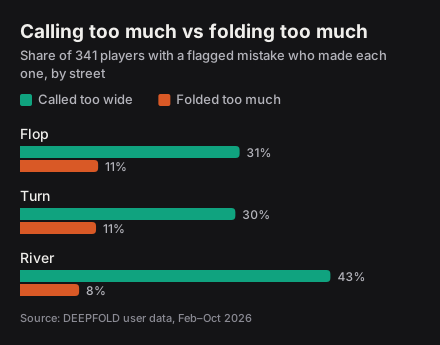
(Percentages use the 341 players with at least one mistake as the denominator.)
Two trends stand out:
- On every street, nearly 3x as many players call too much as fold too much, and on the river the gap widens to 5x.
- The same holds player by player: counting both mistakes, 196 players called too much more often than they folded too much. Only 24 showed the reverse.
A lot of training material warns you not to get bluffed off your hand. That advice helps the few players who are too tight. For most players, the data points the other way: what you need to learn is how to fold.
Where players go wrong on the river
The river is the street with the biggest pot, where every decision costs the most. Of the 238 players flagged for river mistakes, here is how the mistakes break down:
| Rank | River mistake | Players |
|---|---|---|
| 1 | Calling too wide (hero-calling too light) | 62% |
| 2 | Overbluffing | 46% |
| 3 | Overvaluing one pair or two pair, not folding when raised | 39% |
| 4 | Wrong bet sizing | 24% |
| 5 | Missing value bets | 21% |
| 6 | Folding too much | 12% |
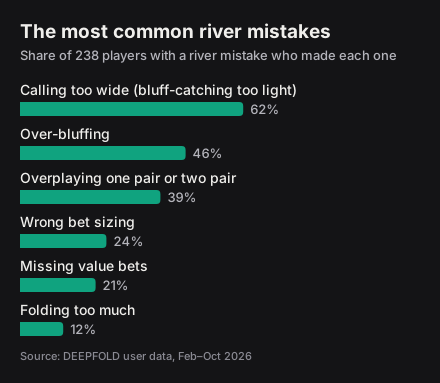
#1 and #3 are really two sides of the same problem: when you hold a hand that "looks good," you can't let it go. The only difference is that #1 is a plain call, while #3 is betting first, getting raised and calling anyway.
#2, overbluffing, ties back to calling stations too. Plenty of bluffs fail because the target is a calling station who won't fold. Later we'll cover how to adjust against one.
Five ways players call too much
"Calling too wide" is an umbrella term. We broke down the mistake descriptions for the 214 players who made it. Below is the share of players who made each type. About half the descriptions only said "called too loose" with no detail and couldn't be classified, so the percentages don't add up to 100%, and one player can make more than one type:
| Rank | How they called too much | Players |
|---|---|---|
| 1 | Calling down the flop and turn with weak hands, no plan | 46% |
| 2 | Bluff-catching the river with marginal hands, hero-calling too light | 46% |
| 3 | Calling big bets, overbets or all-ins without enough hand strength | 24% |
| 4 | Calling after being raised or check-raised | 14% |
| 5 | Ignoring a strong line (a passive player suddenly betting big, multiway pots) | 10% |
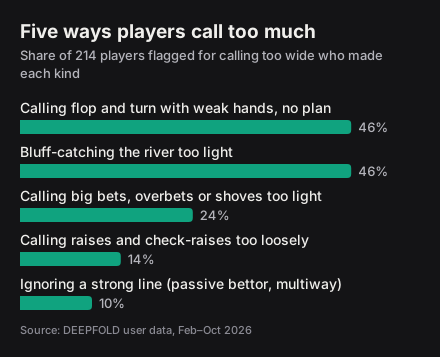
#1 deserves special attention: many tough river spots are created on the flop and turn. You call the flop with third pair "just to see," call the turn again, and by the river the pot is big and you still have third pair. Now calling and folding both hurt. The fix isn't on the river. It's thinking ahead on the earlier streets: if you call with this hand, on which boards and against which sizes do you plan to give up?
Two more observations:
- The button (BTN) and big blind (BB) make the most bad calls: of the 214 players, 50% made this mistake on the BTN and 44% in the BB. The BTN has position, and the BB has already put in a big blind and defends the widest range. Both make it easy to drag weak hands all the way to the river.
- It's worse in cash games than in tournaments: among cash game players with mistakes, 67% called too wide, compared with 51% of tournament players. And 53% of cash players' overcalls happened on the river, versus 36% for tournament players. Tournament stacks are shallower, so players reach the river facing a big bet less often.
What players ask about the river
Now the question side. Of the 494 players who asked real strategy questions, 205 (41%) asked about the river or bluff-catching. Here is the share of those 205 who asked each type of question:
| Rank | Question type | Players who asked |
|---|---|---|
| 1 | Facing a bet with this hand: call or fold? | 49% |
| 2 | Whether to bluff the river, and with what | 32% |
| 3 | Bluff-catching concepts: calling frequency, MDF, pot odds | 27% |
| 4 | River value bets, how much to bet for thin value | 23% |
| 5 | Getting raised or shoved on after betting | 22% |
| 6 | Bet or check the river | 20% |
| 7 | Adjusting to specific opponents | 13% |
| 8 | Blockers | 8% |
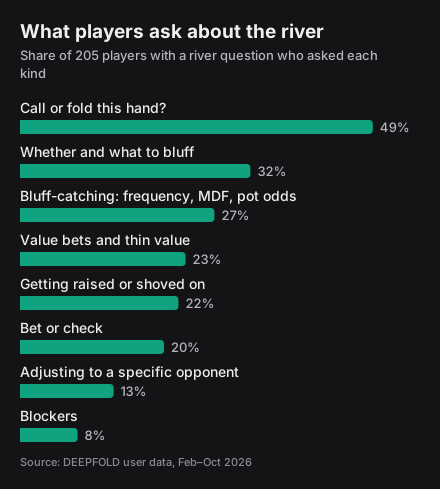
(Another 34% asked other river questions not listed in the table.)
The most common question is "call or fold." The more interesting part is what they were holding. Among the 108 players who asked "call or fold" and described their hand:
| Hand | Players |
|---|---|
| Two pair or better (two pair, three of a kind, straights, flushes) | 62% |
| Second pair or a smaller pair | 34% |
| Top pair or an overpair | 32% |
| No pair (ace-high, king-high) | 17% |
| Missed draws, air | 8% |
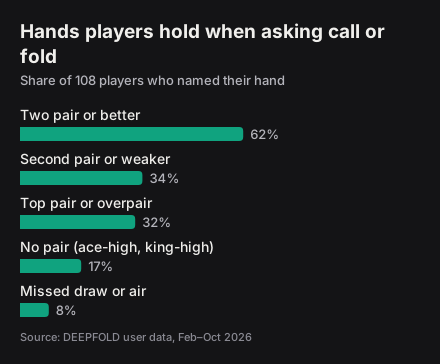
The hardest spots aren't weak hands, they're strong ones. With air, players rarely hesitate. What keeps them up at night is two pair on a four-flush board, or three of a kind on a straight board, facing an all-in and not knowing whether to let it go. Among the 111 players who mentioned the bet size they faced, 62% were facing an all-in.
This lines up with the mistake data: strong hands make you reluctant to let go, weak hands make you curious, and both push you into one extra call.
Call or fold on the river: first work out how often you need to win
To decide whether you can call on the river, the first step is working out the minimum share of the time your call has to win. The formula is: call amount ÷ (total pot after your call). The bigger the bet, the more often you need to win:
| Opponent's bet size | Minimum win rate to call |
|---|---|
| 1/3 pot | 20% |
| 1/2 pot | 25% |
| 3/4 pot | 30% |
| 1x pot | 33% |
| 1.5x pot | 38% |
| 2x pot | 40% |
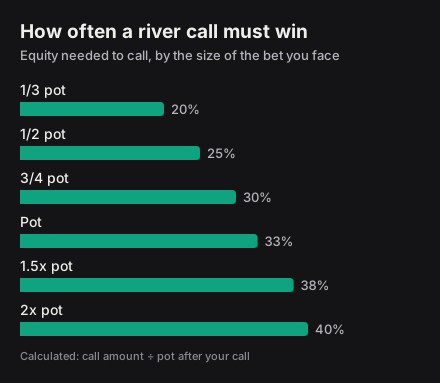
On the river, your hand usually beats only your opponent's bluffs and loses to his value hands. So this number translates directly into: the minimum share of bluffs your opponent's bets need to contain for your call to break even. Facing a pot-sized bet, your opponent needs to be bluffing at least 1/3 of the time.
For more on this calculation, see pot odds and equity and minimum defense frequency (MDF).
A 4-step hero call check: should you call this river?
Step 1: work out the price. Use the table above. For example, if your opponent bets pot, you need to win 33%.
Step 2: count your opponent's value hands and bluffs. Go back over his action on each street and list the value hands and bluffs that would play this way. For example:
- Your opponent bets pot. You estimate he has 12 value combos that would bet like this and 9 missed draws. Bluff share = 9 ÷ (12 + 9) ≈ 43%, which is higher than 33%, so you can call.
- Same board, but your opponent is a passive player who rarely bluffs. With missed draws he mostly checks and gives up, leaving only 3 bluff combos. Bluff share = 3 ÷ (12 + 3) = 20%, which is lower than 33%, so you should fold.
Same hand, same bet, opposite answers. What decides it is your opponent's range, not how good your hand looks.
Step 3: check whether your hand beats any of his value hands. If your hand can't beat even his weakest value bet, it's only a bluff catcher, and you go back to the math in step 2. If it beats some of his value hands, you can call wider. This is also where blockers come in: if your hand blocks his value hands, calling gets better; if it blocks his bluffs, folding gets better. See blocker effects.
Step 4: ask whether the line makes sense. A passive player who suddenly raises or overbets the river, or someone betting big on the river in a multiway pot: in typical games these lines contain very few bluffs. In our data, 10% of the players who called too wide made exactly this mistake.
For the full theory on bluff-catching, read bluff-catching principles and river decision making.
How to play against a calling station
If you're sure the player across from you is a calling station, the adjustment is simple, and it's the exact opposite of everything above:
- Bluff less: a calling station doesn't fold, so your bluffs just give money away. Overbluffing is the second most common river mistake in the data (46%), and many of those bluffs simply picked the wrong target.
- Value bet thinner and bigger: he'll call with second and third pair, so top pair and even middle pair can value bet the river, and you can size up. See value betting.
- Respect his big bets: calling stations rarely bet on their own. When one raises or bets big on the river, he usually has it.
How do you spot a calling station? If you use a HUD, look for players with a high VPIP, lots of postflop calls and low aggression. See the HUD stats guide. For more ways to exploit players, see exploitative play vs GTO.
Are you a calling station? Let AI check for you
All the mistake data in this article comes from the AI coach's hand-by-hand reviews of real player hands. Give your own hands to DEEPFOLD and you'll see on which streets and in which positions you make the most bad calls. DEEPFOLD reads GGPoker hand histories, X-Poker replay links or screenshots directly. Try it free.
Frequently Asked Questions
What is a calling station?
A calling station is a player who rarely bets or raises but calls with almost anything, often calling down to the river with second pair, third pair or even ace-high. They rarely fold, so bluffing them almost never works, but value betting medium-strength hands against them makes a lot of money.
How do you know if you're a calling station?
Look at how often you lose after calling on the river. If you often call and see your opponent show a value hand, or your postflop calls far outnumber your bets and raises, you lean toward being a calling station. In DEEPFOLD's data, 63% of players the AI flagged for mistakes had called too wide after the flop, and 5x as many players called too much on the river as folded too much.
When should you make a hero call on the river?
A hero call is calling a big bet with a hand that only beats bluffs. It only pays off when your opponent's bluff share is higher than the win rate you need: against a pot-sized bet, he needs to be bluffing at least 1/3 of the time; against a 2x pot bet, at least 40%. The more passive the opponent, and the fewer bluffs his line contains, the less you should hero call.
How should you play against a calling station?
Bluff less and value bet more. A calling station rarely folds, so bluffing has low expected value. But he will call with weak hands, so you can value bet the river with top pair or even middle pair, and you can size up. When a calling station suddenly bets big or raises on the river, he usually has a strong hand, and you should respect it.
Methodology and limitations
- Mistake data: From February to October 2026, 354 players uploaded 5,614 key hands that the AI reviewed hand by hand. A language model first grouped the AI's written mistake descriptions into 17 categories. "Calling too wide after the flop" appeared 784 times across 214 players, and we then split it into this article's five types based on the descriptions. Street and position follow the AI's tags.
- Question data: Over the same period, 1,534 messages to the DEEPFOLD chat coach dealt with river decisions or bluff-catching (205 players, excluding follow-ups, product questions and small talk). Each message was tagged with its main question type, hand strength and the bet size faced, and we spot-checked a sample by hand.
- How we counted: Rankings use the share of players who made a mistake or asked a question, so a few very active askers (the top 5 sent about 45% of the messages) can't skew the results.
- Limitations: The AI prioritizes big-pot key hands for review, and hands that reach the river are more likely to be picked, so the share of players who call too much doesn't mean every call you make is wrong. But calling too much and folding too much are subject to the same selection, so the gap between them is still meaningful. The pot-odds table is calculated, not user data.
- Privacy: All numbers are anonymous aggregates. The examples in this article are paraphrased and don't quote any player directly.