Poker Tournament Strategy: What 208 MTT Players Ask and Get Wrong
208 tournament players most often ask about overall strategy, postflop play and calling all-ins. But when the AI reviewed their hands, the top mistakes were postflop errors (86%) and loose preflop play (74%). Includes a call-the-shove equity table.
The biggest difference between tournaments and cash games is that stacks get shallower as you go. You start with 100BB or more, and late in an MTT you often have just 10-20BB, where every hand comes down to "shove or fold." So many players assume that bad poker tournament strategy just means not knowing your push/fold charts well enough.
DEEPFOLD's data says it isn't that simple. This article uses two data sets to answer two questions: what do tournament players actually ask the AI coach, and what mistakes does the AI find most often when it reviews their hands?
About the data: from February to October 2026, 494 players asked the DEEPFOLD AI coach real strategy questions. 208 of them (42%) asked about tournaments, in 2,303 messages. The mistake data comes from tournament hands uploaded by 98 players over the same period and reviewed hand by hand by the AI; 95 of those players had at least one mistake flagged. All figures are anonymized aggregates, and rankings show the share of players who asked about or made each one.
Key takeaways
- 2 in 5 players who ask strategy questions have asked about tournaments: 208 out of 494.
- The most common topic isn't push/fold charts, it's overall strategy: 40% asked how to go deeper or plan their game. Next came postflop play (33%) and whether to call someone's all-in (29%).
- 20BB is the dividing line: below 20BB, about two-thirds of questions are all-in decisions. Above 20BB, postflop questions take over.
- The AI flags the most mistakes postflop and in preflop entry: of the 95 tournament players with mistakes, 86% made postflop errors and 74% opened or defended too loosely preflop.
- When it comes to all-ins, too loose is far more common than too tight: 47% of players shoved or called shoves too wide. Only 15% were too tight (not shoving when they should, folding to shoves).
What tournament players ask the AI coach
We classified all 2,303 tournament questions by what each one was mainly about. Here is the share of the 208 players who asked about each topic:
| Rank | Question type | Players who asked |
|---|---|---|
| 1 | Overall strategy: going deeper, study plans, results review | 40% |
| 2 | Postflop play in tournament hands | 33% |
| 3 | Whether to call someone's all-in | 29% |
| 4 | Opening, stealing the blinds, defending the BB (with antes) | 26% |
| 5 | Should I shove or fold this hand | 26% |
| 6 | Reshoving (3-bet all-in over an open) | 23% |
| 7 | ICM, the bubble, pay jumps | 17% |
| 8 | Early stages and deep-stack play | 13% |
| 9 | Final table | 12% |
| 10 | Bounty tournaments (PKO) | 10% |
| 11 | Satellites | 7% |
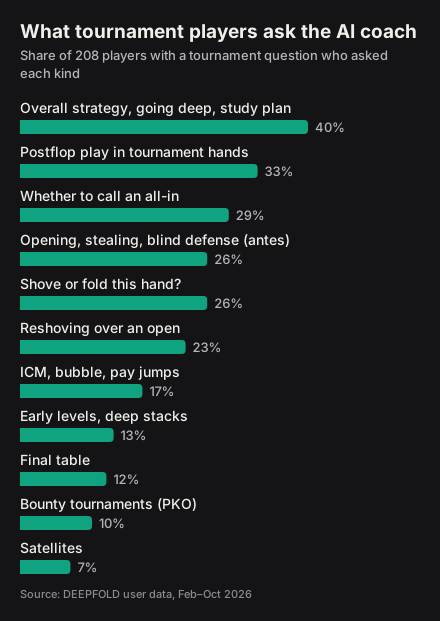
A few things stand out:
- Add shoves and reshoves together and 37% of players asked whether to go all-in; 29% asked whether to call one. Being on the other side of a shove is just as much of a headache.
- Postflop questions rank second. In the early and middle stages stacks are still deep, and postflop play looks a lot like a cash game. But most tournament tips only cover short stacks.
- Among players who mentioned the format, 14% played bounty tournaments, 15% played live tournaments, 8% played satellites and 7% played SNGs or Spin & Gos.
For push/fold and ICM basics, start with our push/fold guide and our explainer on what ICM is.
Your stack depth decides what you ask
128 players stated their stack size in their questions. Group the questions by stack depth and there's a clear dividing line:
| Stack depth | All-in decisions (shove, reshove, call a shove) | Postflop play |
|---|---|---|
| Under 10BB | 69% | 5% |
| 10-20BB | 65% | 5% |
| 20-40BB | 29% | 33% |
| 40BB+ | 15% | 38% |
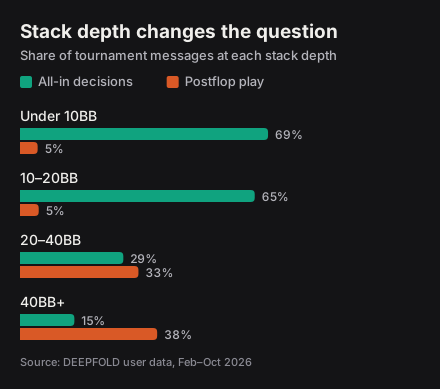
(Percentages are the share of messages at each stack depth that fall into each category. The rest are other topics like opening and ICM.)
Below 20BB, a tournament is almost entirely an all-in game. Above 20BB, the questions move back to postflop. That means tournament players need two skill sets: push/fold ranges for short stacks, and cash-game-style postflop play for medium and deep stacks.
Now look at tournament stages. 109 players said which stage they were in:
| Tournament stage | Players who asked |
|---|---|
| Early | 46% |
| Middle | 40% |
| Bubble | 38% |
| Final table | 31% |
| In the money | 25% |
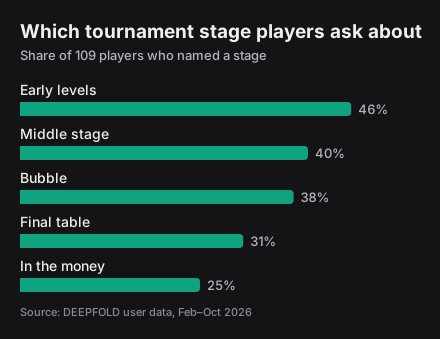
Bubble questions are almost all about ICM: how to adjust your ranges near the money, and whether to call a big stack's shove. For stage-by-stage play, see our guide to tournament stages and our final table strategy guide.
The poker tournament strategy mistakes the AI flags most
What players ask is one thing. The mistakes they actually make are another. Among the 95 tournament players with mistakes, here is the share who made each type:
| Rank | Tournament mistake | Players who made it |
|---|---|---|
| 1 | Postflop errors (calling too much, over-bluffing, overvaluing one pair) | 86% |
| 2 | Opening, calling or defending too loosely preflop | 74% |
| 3 | Shoving or reshoving too wide | 41% |
| 4 | Wrong open or 3-bet sizing with a short stack | 27% |
| 5 | Calling shoves too wide | 24% |
| 6 | Folding too much with a short stack, folding to shoves | 12% |
| 7 | Not shoving when you should | 5% |
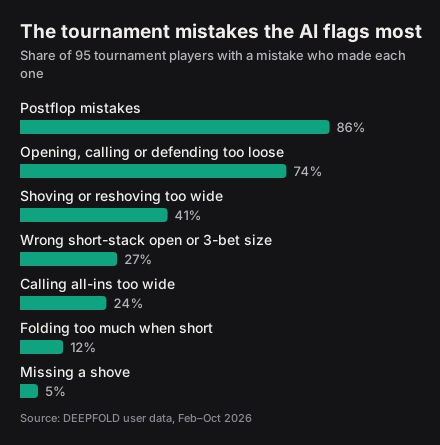
Compared with the questions, there are two gaps:
- Players care most about push/fold, but they make the most mistakes postflop and in preflop entry. Tournaments already have a higher share of preflop mistakes: in our data on the 10 most common poker leaks, 49% of tournament mistakes happened preflop versus 26% in cash games. But the most common preflop mistake isn't push/fold. It's opening and calling too loosely while stacks are still deep.
- Short-stack sizing mistakes (27%) are more common than most people think. For example, you open to 2.5BB with 15BB, face a 3-bet shove and have to fold. That throws away about 17% of your stack for nothing. At this depth, many hands play better as a straight shove or a min-raise.
Too loose with all-ins is far more common than too tight
Split the all-in mistakes into "too loose" (shoving too wide, calling shoves too wide) and "too tight" (not shoving when you should, folding to shoves):
| Too loose | Too tight | |
|---|---|---|
| Players who made it | 47% | 15% |
| Share of all-in mistakes | 83% | 17% |
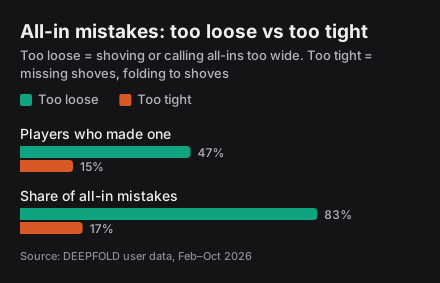
This matches what we saw in our calling station data: players mostly lose by putting in too much, not too little. In tournaments, that means shoving too many marginal hands, or calling shoves with them too often.
Should you call the shove? First work out the equity you need
Calling a shove is one of the most expensive decisions in a tournament. Take the most common spot: the button shoves, the small blind folds, and you're in the big blind with a BB ante (the big blind posts a 1BB ante each hand). Here is the minimum equity you need to call:
| Button shove size | Minimum equity for the BB to call |
|---|---|
| 8BB | 40% |
| 10BB | 42% |
| 15BB | 44% |
| 20BB | 46% |
| 25BB | 47% |
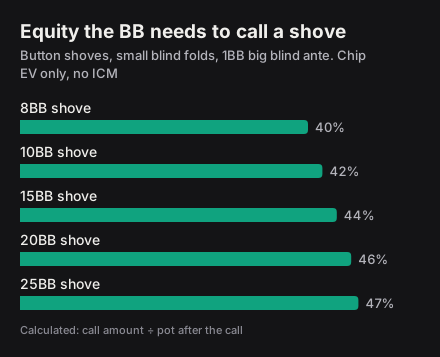
The bigger the shove, the more equity you need, because the big blind you've already put in is a smaller share of the pot.
Let's run an example. Say the button shoves 10BB with a wide range: any pair, any ace, most kings and some queens and jacks (about 35% of all starting hands). In the big blind you need 42%:
- A7o has about 49% and 55 has about 52%: both clear 42%, so call.
- A2o has about 44% and K9o about 43%: just over the line, a small chip-EV winning call.
- QTo and J9s have about 41%, K5s about 40%: just short, so fold.
(Equities are from computer simulation.)
This table only covers chip EV. On the bubble or at the final table, ICM raises the equity you need, because what you lose when you bust is worth more than what you gain when you win. So those "just over the line" calls above should usually become folds on the bubble. For more, see our guide to ICM pressure.
To practice your push/fold ranges, use DEEPFOLD's push/fold trainer.
Why the AI rarely flags ICM mistakes
17% of players asked about ICM, the bubble or pay jumps. Yet in the tournament hands the AI reviewed, almost no mistake descriptions mention ICM. That doesn't mean players handle ICM well. It's because hand histories usually don't include the payout structure or how many players are left, so the AI can't tell how close a hand is to the bubble.
So for ICM spots, the most reliable approach is to add that information yourself. When you upload or ask, write down how many players are left, how many get paid and each player's stack. Then the AI coach can review the hand with ICM in mind.
Let the AI review your tournament hands
All the mistake data in this article comes from the AI coach reviewing players' real tournament hands one by one. Give your tournament hands to DEEPFOLD and you'll see at which stack depths and stages you make the most mistakes. DEEPFOLD reads GGPoker hand histories, X-Poker replay links or screenshots directly. Try it free.
Frequently Asked Questions
What are the most common mistakes in tournament poker?
In the tournament hands the AI reviewed, the most common were postflop errors (86% of players with mistakes made them), followed by opening or defending too loosely preflop (74%) and shoving too wide (41%). Among all-in mistakes, too loose made up 83% and too tight only 17%. For most players, fixing poker tournament strategy starts with postflop play and preflop discipline, not just push/fold charts.
When should you switch to push/fold in a tournament?
The data shows a clear split around 20BB: below 20BB, about two-thirds of players' questions are all-in decisions, and above 20BB, postflop play dominates. In general, at around 10BB or less you mostly shove or fold, and at 10-20BB you mix shoves, reshoves and small opens.
How much equity does the big blind need to call a shove?
Take a button shove with the small blind folding and a BB ante in play. Against a 10BB shove, the big blind needs about 42% equity; against 20BB, about 46%. These are chip-EV thresholds only. On the bubble or at the final table, ICM pushes the required equity higher.
Where does this data come from?
From 2,303 tournament questions that 208 players asked the DEEPFOLD AI coach between February and October 2026, plus tournament hands uploaded by 98 players and reviewed hand by hand by the AI. All numbers are anonymized aggregates, ranked by the share of players who asked about or made each one.
Methodology and limitations
- Question data: from DEEPFOLD chat coach messages between February and October 2026, we took questions that were marked as tournament questions or dealt with push/fold, ICM or bounties (excluding follow-ups, product questions and small talk). That gave 2,303 messages from 208 players. A language model then tagged each message's main question type, tournament stage, stack depth and format, with manual spot checks.
- Mistake data: from AI-reviewed hands tagged as tournament hands over the same period, we took 934 mistake descriptions (95 players) and grouped them into the types in this article. About a third of players had mistakes described too vaguely to classify; those are not in the tables.
- How we counted: rankings use the share of players who asked about or made each one, so a few very active players (the top 5 sent about 39% of messages) don't skew the results. The stack depth table is based on message counts.
- Limitations: stack depth and stage are only counted when the message states them. The AI prioritizes big-pot key hands for review, which may inflate postflop mistakes. Hand histories usually lack payout structures, so ICM mistakes are almost impossible to flag. The required equities are calculated and the hand equities come from computer simulation; neither is user data.
- Privacy: all numbers are anonymized aggregates. Examples in the text are paraphrased and don't quote any player's actual words.