3-Bet Pots: What 250 Players Ask and Get Wrong (Data)
Most 3-bet questions are about what comes after: 54% of players asked how to play the 3-bet pot postflop. AI-reviewed hands show the top 3-bet mistake is calling too wide (60%), not folding too much (7%).
The 3-bet is the topic DEEPFOLD players ask about most. But when you break those questions down one by one, the sticking point is not "should I 3-bet?" It is what happens after the 3-bet: the pot is bigger, the stacks are relatively shallower, and players don't know how to play the flop.
This article uses two data sets to answer two questions. What are players actually asking when they ask about 3-bets? And when the AI reviews their hands, which 3-bet decisions does it flag most often?
About the data: Between February and October 2026, 250 of the 494 players (51%) who asked the DEEPFOLD coach a real strategy question asked about making or facing a 3-bet, in 2,516 messages. The mistake data comes from 5,614 key hands uploaded by 354 players in the same period and reviewed hand by hand by the AI. All figures are anonymous aggregates, ranked by the share of players who asked about or made each one.
Key Takeaways
- One in two players with a strategy question asked about 3-bets: 250 of 494.
- The most common question is what to do after the 3-bet: 54% asked how to play the 3-bet pot after the flop, more than asked whether a hand is worth a 3-bet at all (39%).
- JJ is the most-asked hand: among players who named a specific hand, 33% asked about JJ, followed by AA, QQ and KK (31% each).
- The most common 3-bet mistake is calling too much: among players with a 3-bet mistake, 60% were flagged for calling 3-bets too wide. Only 7% were flagged for folding too much to 3-bets.
- Cash and tournament players struggle with different things: cash players ask most about postflop play (60%), tournament players about short-stack 3-bet shoves (57%).
What Players Ask When They Ask About 3-Bets
We sorted all 2,516 3-bet questions by their main subject. Here is the share of the 250 players who asked about each:
| Rank | Question | Players who asked |
|---|---|---|
| 1 | How to play the 3-bet pot after the flop | 54% |
| 2 | Should I 3-bet, call or fold this hand? | 39% |
| 3 | 4-bets, 5-bets and preflop all-ins | 27% |
| 4 | Concepts: polarized, linear, 3-bet frequency | 22% |
| 5 | Short stacks and tournament 3-bets | 20% |
| 6 | Adjusting to a specific opponent | 16% |
| 7 | Squeezes | 15% |
| 8 | 3-bet sizing | 14% |
| 9 | Which hands to 3-bet as a bluff | 11% |
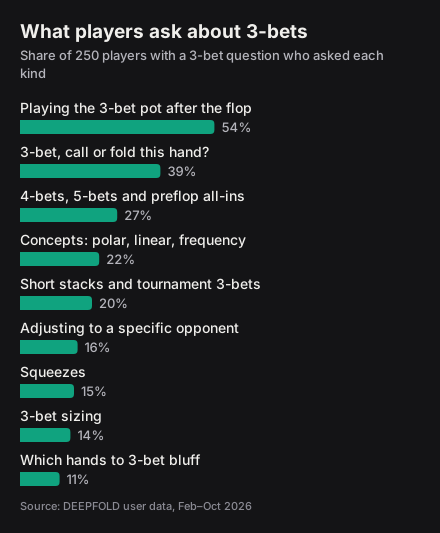
A few things stand out:
- There are more postflop questions than preflop ones. Most 3-bet material stops at preflop: range charts, sizing, frequencies. What actually leaves players stuck mid-hand is the flop and turn after the 3-bet gets called.
- More players ask about making 3-bets than facing them: 72% asked about a spot where they 3-bet, 57% about facing someone else's 3-bet.
- When making a 3-bet, the most-asked position is the small blind (44%), then the button (38%) and big blind (37%). When facing a 3-bet, the most-asked spot is opening UTG and getting 3-bet (47%): the tightest opening range is the one players least want to fold.
We already cover the preflop side in depth: What Is a 3-Bet, 3-Bet Strategy Guide, Facing a 3-Bet and The Squeeze Play. This article focuses on the part players ask about most and most guides skip.
Why 3-Bet Pots Are Hard: The SPR Drops
The real difference between a 3-bet pot and a single-raised pot is not that the pot is bigger. It is that the remaining stacks are much smaller relative to the pot. That ratio is the stack-to-pot ratio (SPR: effective stack ÷ pot on the flop), and it decides whether your hand is worth getting all in with.
At a 6-max table with 100BB effective and common raise sizes:
| Pot type | Preflop action | Flop pot | Stacks behind | SPR |
|---|---|---|---|---|
| Single-raised pot | CO opens 2.5BB, BTN calls | 6.5BB | 97.5BB | about 15 |
| 3-bet in position | CO opens 2.5BB, BTN 3-bets to 8BB, CO calls | 17.5BB | 92BB | about 5.3 |
| 3-bet out of position | BTN opens 2.5BB, SB 3-bets to 11BB, BTN calls | 23BB | 89BB | about 3.9 |
| 4-bet pot | CO opens 2.5BB, BTN 3-bets to 8BB, CO 4-bets to 20BB, BTN calls | 41.5BB | 80BB | about 1.9 |
(Each pot includes the folded blinds.)
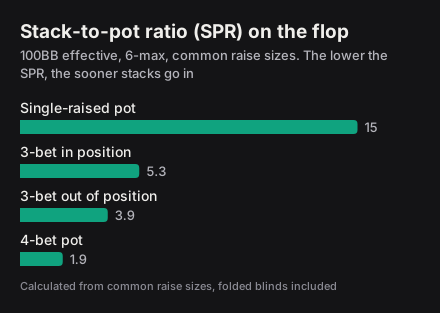
An SPR that falls from 15 to 4 or 5 means one or two bets on the flop put the stacks in. That changes three things in practice:
- One pair is worth more. In a single-raised pot, top pair is often a medium-strength hand. In a 3-bet pot at an SPR of about 4, overpairs and top pair with a good kicker are usually worth stacking off with. In a 4-bet pot with an SPR under 2, a pair or better on the flop is very hard to fold in most spots.
- You need a plan before the flop. Many players ask "I bet the flop and got raised on the turn, now what?" The answer was decided when you bet the flop: once the pot is big enough that folding hurts, you should not be putting in big bets with a hand that can't go all the way.
- Draws and speculative hands are worth less. With shallow stacks there is little extra to win when you hit, so small pairs and suited connectors, which rely on hitting big to win big pots, have worse implied odds in a 3-bet pot than in a single-raised pot.
When you are the 3-bettor: your edge is on high-card boards
A 3-betting range is usually more concentrated in hands like AA, KK and AK than a calling range, so:
- Dry ace-high and king-high boards (for example A-8-3 rainbow) favor the 3-bettor most. You can bet small (about 1/3 pot) at a high frequency.
- Low and middle connected boards (for example 8-7-5, or 7-6-4 two-tone) are closer to the caller's range: the caller has more two pairs, sets and straights. Check more here, instead of betting automatically because you were the preflop raiser.
When you called the 3-bet: your range is more capped
When you call a 3-bet, you usually 4-bet your very strongest hands like AA and KK, so your calling range has fewer top-end hands. That means:
- Don't overfold to small bets. When the 3-bettor bets small at a high frequency on dry boards, there is a lot of air in that range, and your middle pairs and ace-high often have enough equity to continue.
- Raise more selectively. At a low SPR, a flop raise is close to committing your stack, so raise with hands that can stand an all-in.
- Calling 3-bets out of position is the most costly spot, which is exactly the most common problem in the mistake data below.
Further reading: Range Advantage, C-Bet Strategy Guide, Board Texture Analysis, Equity Realization
The Most-Asked Hands: JJ, QQ, TT and Other In-Between Pairs
118 players named a specific hand in a 3-bet question. The most-named hand is not AK but the middle-to-high pairs:
| Hand | Players who asked |
|---|---|
| JJ | 33% |
| AA | 31% |
| 31% | |
| KK | 31% |
| TT | 25% |
| 99 | 23% |
| AK | 23% |
| 88 | 19% |
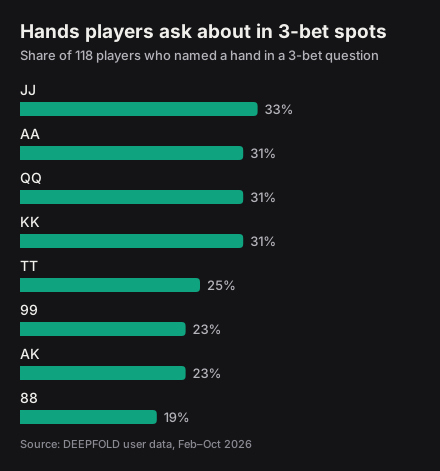
Questions about AA and KK are mostly "my 3-bet got called and an ace hit the flop, now what?" or "how do I get the most value?" Questions about JJ, QQ and TT are nearly always the same worry: the hand is too good to fold, but against a 4-bet or 5-bet it might run into a bigger pair.
This kind of decision comes down to simple arithmetic. Example:
You open JJ from the CO for 2.5BB, the BTN 3-bets to 8BB, you 4-bet to 20BB, and the BTN shoves 100BB. Both blinds have folded. You need to call 80BB more, and the pot after your call is 201.5BB, so you need about 40% equity to call profitably.
JJ's equity depends entirely on the range the opponent shoves:
| Opponent's shoving range | JJ's equity | Decision |
|---|---|---|
| KK and AA only | about 19% | Fold |
| QQ+ and AK | about 36% | Fold |
| QQ+ and AK, plus A5s and A4s as bluffs | about 42% | Call |
(Equities from a computer simulation, rounded to whole numbers.)
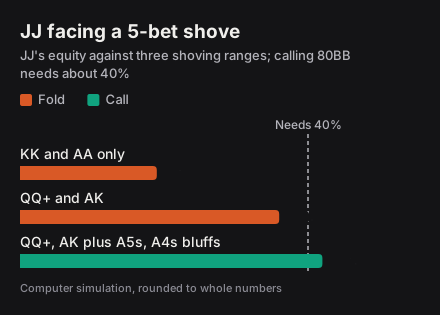
Against the same QQ+ and AK shoving range, TT has about 37%. QQ against KK+ and AK has about 40%, right on the threshold. The takeaway is not "always call JJ" or "always fold JJ." It is whether the opponent's 5-bet shoving range contains any bluffs. In most low-stakes games, a preflop 5-bet shove is almost always value, and calling with JJ or TT usually loses money.
Further reading: Pocket Pairs Strategy, Pot Odds and Equity, Blocker Effects
The 3-Bet Mistakes the AI Catches: Calling Too Much, Not Folding Too Much
Of the 354 players who uploaded hands, 133 (38%) had at least one key hand where the AI flagged a problem related to a 3-bet or 4-bet. Leaving out the hands that were played fine, here is the share of the 129 players with an actual mistake who made each kind:
| Rank | Mistake | Players who made it |
|---|---|---|
| 1 | Calling 3-bets / 4-bets too wide (especially out of position) | 60% |
| 2 | Overplaying 4-bets and 5-bets, stacking off too light preflop | 29% |
| 3 | 3-betting too light or with the wrong hands | 25% |
| 4 | Misplaying the 3-bet pot postflop | 25% |
| 5 | Wrong 3-bet / 4-bet sizing | 17% |
| 6 | Folding too much to 3-bets | 7% |
| 7 | Flatting where a 3-bet is better | 3% |
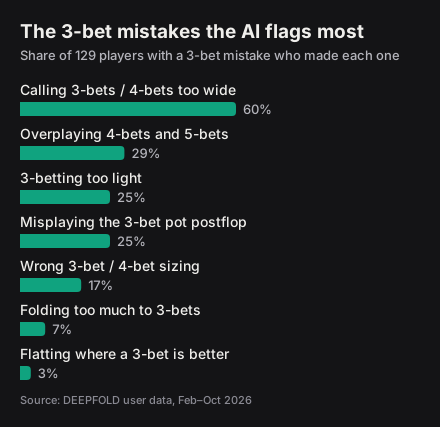
This matches the overall pattern in Common Poker Mistakes: players mostly over-invest, not under-invest. Players flagged for calling 3-bets too wide outnumber those flagged for folding too much to 3-bets by almost 9 to 1.
1. Calling 3-bets too wide: 60% of players
The flagged hands came most often from the BTN (38%), followed by the two blinds (32% each). Typical cases:
- Calling out of position with offsuit broadways such as KJo, QJo and ATo. After the flop these are often dominated by AK, AQ and KQ, and even top pair is hard to play.
- Calling a 3-bet with small pairs just to set-mine. With an SPR of only 4 to 5, the chips you win when you hit a set are not enough to make up for the times you miss.
How to fix it: against a 3-bet, give marginal hands only two of the three options: 4-bet or fold. Save calls for hands you can play well after the flop in position, such as suited broadways and middle pairs.
2. Overplaying 4-bets and 5-bets: 29%
These mistakes include 4-bet bluffing with hands that are too weak, and 5-bet shoving hands like JJ or TT after being 4-bet. The problem is usually not the hand but ignoring the opponent: against someone who rarely 3-bets, the 3-bet range is strong and a 4-bet bluff rarely gets a fold.
How to fix it: keep 4-bet bluffs to hands with blockers (such as A5s and A4s), and use them only against opponents who 3-bet often. Facing a preflop shove, estimate the opponent's range first, using the JJ arithmetic above.
3. 3-betting too light: 25%
After learning that "you need bluff 3-bets," many players start 3-betting hands like K9o and Q8o. When called, the flop is hard to play; when 4-bet, they can only fold.
How to fix it: choose bluff 3-bets that still have a way forward when called: suited aces with small kickers (A5s to A2s) and suited connectors (76s, 65s). Against opponents who don't fold, bluff less and 3-bet more for value.
4. Misplaying the 3-bet pot postflop: 25%
The most common pattern is betting big on the flop, getting raised on the turn and only then realizing the hand can't go all the way, or folding an overpair in a pot where the SPR is already very low. Go back to the SPR table above: plan a 3-bet pot before the flop.
Further reading: Facing a 3-Bet, 3-Bet Strategy Guide, Polarized Ranges, Exploitative vs GTO
Cash Games vs Tournaments: Different 3-Bet Problems
| Question | Cash players (119) | Tournament players (68) |
|---|---|---|
| How to play the 3-bet pot after the flop | 60% | 32% |
| 4-bets, 5-bets and preflop all-ins | 34% | 31% |
| Should I 3-bet, call or fold this hand? | 31% | 41% |
| Short-stack 3-bet shoves, stack depth | 5% | 57% |
| Adjusting to a specific opponent | 19% | 12% |
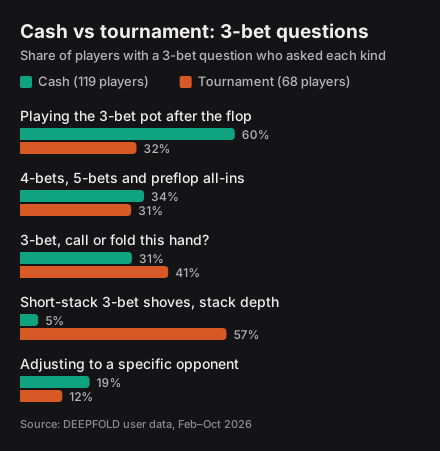
Tournament stacks are often only 20 to 40BB, where a 3-bet often means going all in. So tournament players mostly ask "can I 3-bet shove with this stack?" and whether to tighten up under ICM pressure. Cash games are usually played 100BB deep or more, so postflop questions naturally come up more.
Further reading: Push/Fold Complete Guide, What Is ICM, Deep Stack Strategy
How to Use This Data
- Check your calling range against 3-bets first. It is the most common leak. List the offsuit hands you call 3-bets with out of position; most of them should become a 4-bet or a fold.
- Think about the flop before you 3-bet. In a pot with an SPR of 4 to 5, one or two flop bets get the stacks in. When you decide to 3-bet or call a 3-bet, know which flops you will play for stacks.
- Facing a 4-bet or 5-bet, estimate the range before you count the odds. Whether JJ can call depends on whether the opponent has bluffs, not on whether JJ is a big hand.
The DEEPFOLD AI coach can read GGPoker hand histories, X-Poker replay links or screenshots directly and flag every decision you make in a 3-bet pot. Try it free.
FAQ
How is a 3-bet pot different from a single-raised pot?
The biggest difference is the stack-to-pot ratio (SPR). At 100BB, a single-raised pot has an SPR of about 15 on the flop, a 3-bet pot about 4 to 5, and a 4-bet pot under 2. The lower the SPR, the more one pair is worth stacking off with, and one or two flop bets commit the stacks, so plan a 3-bet pot before the flop.
How should I play JJ after a 3-bet?
Facing a 3-bet at 100BB, JJ is usually not a fold; you can call or 4-bet. The hard spot is a 5-bet shove: if the opponent shoves only QQ+ and AK, JJ has about 36% equity, below the roughly 40% needed to call, so fold. If the opponent also shoves A5s and A4s as bluffs, JJ has about 42% and calling is profitable.
What is the most common 3-bet mistake?
In AI-reviewed hands, the most common is calling 3-bets too wide: 60% of players with a 3-bet mistake made it, especially calling out of position with offsuit hands like KJo, QJo and ATo. Next come overplaying 4-bets and 5-bets (29%) and 3-betting too light (25%). Only 7% folded too much to 3-bets.
Where does this data come from?
From 2,516 3-bet questions that 250 players asked the DEEPFOLD AI coach between February and October 2026, and 5,614 key hands uploaded by 354 players and reviewed hand by hand by the AI. All figures are anonymous aggregates, ranked by the share of players who asked about or made each one.
Methodology and Limitations
- Question data: messages sent to the DEEPFOLD chat coach from February to October 2026. A language model first tagged the questions about making or facing 3-bets (excluding follow-ups, product questions and small talk): 2,516 messages from 250 players. Each was then tagged with its main question type, the hands named and the positions, with manual spot checks.
- Mistake data: of the 5,614 AI-reviewed key hands from the same period, 414 hands from 133 players carried a mistake label related to 3-bets, 4-bets, 5-bets or squeezes, which were then grouped by mistake type.
- How rankings are calculated: by the share of players who asked about or made each one. 3-bet questions are highly concentrated (the top 5 players sent 45% of the messages), so message counts are not used for ranking.
- Limitations: the AI prioritizes big pots when choosing key hands, and 3-bet pots are big by nature, so the mistake rates do not mean every 3-bet goes wrong. Positions and hands are counted only when a message states them. Equities come from simulation; real decisions also depend on opponent tendencies.
- Privacy: all figures are anonymous aggregates, examples are paraphrased, and no player's original words are quoted.