Poker Downswings and Variance: 66 Players and What the AI Found
66 players talked downswings and tilt with an AI coach. 63% of those who gave a reason blamed luck, yet only 1% of 5,614 AI-reviewed hands were pure luck.
After a losing night, the first thought is usually that the cards were just terrible. Getting rivered, losing with AA to a weak hand, going days without a winning session: every poker player has been there. The real question is which losses were luck and which ones you actually played your way into.
This article uses two sets of DEEPFOLD data to answer that. When players talk to the AI coach about the mental game, what's bothering them, and how do they explain their losses? And when the AI reviews their hands, how many of those losses really couldn't have been avoided?
About the data: from February to October 2026, 494 players asked the DEEPFOLD AI coach real strategy questions. 66 of them (13%) talked about mental-game topics such as downswings, luck, tilt or motivation, in 667 messages. The hand data comes from 5,614 key hands uploaded by 354 players over the same period and reviewed hand by hand by the AI. All figures are anonymized aggregates, and rankings show the share of players who talked about each topic.
Key takeaways
- The most common topics are bad beats, downswings and pressure: of the 66 players, 35% complained about a specific bad beat, 33% talked about a losing streak, and 33% talked about pressure and confidence when facing strong players.
- After a loss, most players blame luck first: of the 49 players who explained why they lost, 63% blamed luck at least once and 55% blamed luck most of the time. Only 37% mainly questioned their own play.
- The AI rarely calls it pure luck: of the 5,614 key hands the AI reviewed, only 1% were judged a cooler or pure luck, 71% had a mistake flagged and 24% were played fine.
- Many "downswings" are tiny samples: among messages that gave a hand count, 78% were about results over 1,000 hands or fewer, and no one talked about more than 10,000 hands. Among players who said how much they lost, 69% mentioned losses of under 5 buy-ins.
- Winners can lose for a long time too: a player who wins 5BB per 100 hands still has a 44% chance of being behind after 1,000 hands, and a 31% chance after 10,000 hands.
What players talk about with the AI coach on the mental game
We classified all 667 mental-game messages by what each one was mainly about. Here is the share of the 66 players who talked about each topic:
| Rank | Topic | Players who talked about it |
|---|---|---|
| 1 | Complaining about specific bad beats, coolers or lost all-ins | 35% |
| 2 | Losing streaks, downswings, giving back winnings | 33% |
| 3 | Pressure and confidence: fear of strong players, fear of losing money | 33% |
| 4 | Tilt, losing control, playing worse after losses | 32% |
| 5 | Luck itself: running below EV, how much variance is normal | 30% |
| 6 | Was this loss a mistake or just bad luck? | 29% |
| 7 | Playing habits: session length, when to stop, hand-volume goals | 26% |
| 8 | Motivation: boredom, burnout, wanting to quit | 18% |
| 9 | Bankroll and stakes after losing | 11% |
| 10 | Suspecting the site or a rigged deal | 8% |
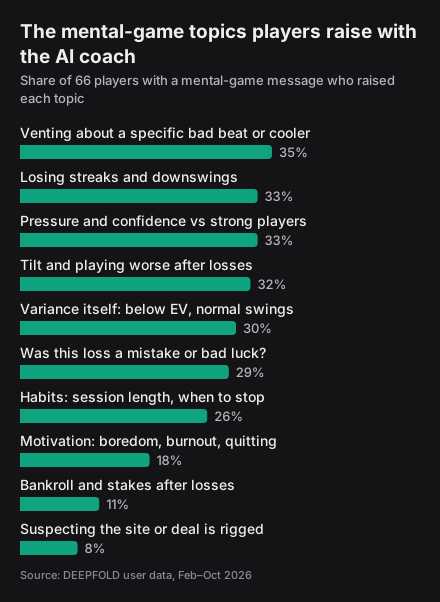
A few things stand out:
- Each of the top 6 topics came up for roughly three in ten players. Mental-game problems rarely come alone: players who complain about bad beats are often also asking whether they misplayed the hand, and worrying that they're about to tilt.
- Only 8% suspected the game was rigged. Most players get frustrated when they lose, but don't go as far as thinking the game is crooked.
- Few players raised motivation (18%), but they talked about it at length. A handful of players kept coming back to whether they should keep playing, and that accounted for 15% of all mental-game messages.
For the types of tilt and how to control them, start with "The Mental Game of Poker: Tilt Types, Emotional Control & Peak Performance".
Was it luck, or was it you?
About half of the messages explain why the player lost. Here is what the 49 players who gave a reason mainly blamed:
| Main explanation | Players (by each player's most common explanation) | Messages |
|---|---|---|
| Luck, lucky opponents, something wrong with the game | 55% | 63% |
| Their own mistakes | 37% | 29% |
| Not sure, asking the AI which it was | 8% | 8% |
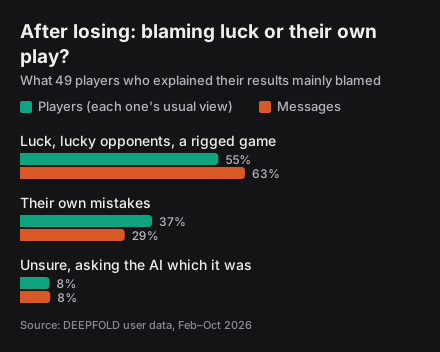
More than half of players blame luck for their losses most of the time. Counting anyone who said it at least once, 63% of players blamed luck and 59% also questioned their own play. Many said both, depending on how painful that day's loss was.
That's natural: when you lose, luck is the most obvious explanation. But judging only by results means missing the things you could actually fix.
What the AI found: only 1% was pure luck
From the hands uploaded by 354 players, the AI coach picked out 5,614 key hands and reviewed each one. Here is how they were judged:
| AI verdict | Share of key hands |
|---|---|
| Mistake found | 71% |
| Played fine | 24% |
| Too vague to judge | 4% |
| Cooler or pure luck | 1% |
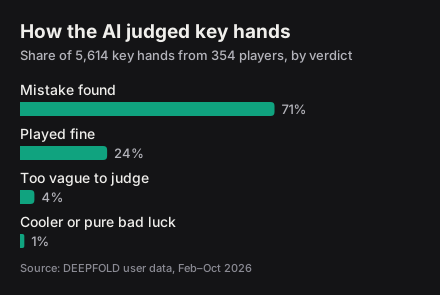
Only 1% of key hands were judged "nothing you could do, just luck". In most big pots, at least one decision could have been played better.
Read this number with care:
- These are two different groups of players. Only 38 of the 66 players who talked about the mental game also uploaded hands, so we can't say that the players who blame luck were actually playing badly.
- The AI picks key hands, usually big pots, where mistakes are more likely to begin with. And the AI's job is to find things to improve, so its standard is on the strict side.
- Losing a hand you played well is real bad luck. Those hands don't need fixing, only accepting. The ones to work on are the 71% where a mistake was flagged.
For the types of mistakes and how to fix them, see "Common Poker Mistakes: 5,614 Hands Show Players Over-Invest".
Your downswing might only be 1,000 hands
Plenty of players write that they've been running bad lately, but most don't say how much they lost or how many hands they played. For the 14 players who gave a hand count, here is the sample size they were talking about:
| Hands mentioned | Share of messages |
|---|---|
| 1,000 hands or fewer | 78% |
| 1,000-10,000 hands | 22% |
| Over 10,000 hands | 0% |
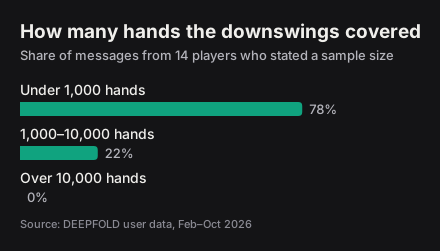
10 of the 14 players only ever talked about results over 1,000 hands or fewer, and the other 4 went up to 10,000 hands at most. No one described a downswing of more than 10,000 hands. Of the 16 players who said how much they lost, 11 (69%) mentioned losses of under 5 buy-ins.
Both groups are small, but they point the same way: what makes players miserable and starts them doubting themselves is often a loss of a few hundred hands and a few buy-ins. As the next section shows, that range is completely normal for a winning player.
How long a winner can still be losing
Say you're a steady winner at 5BB per 100 hands (a solid win rate in low-stakes cash games), with a standard deviation of 100BB per 100 hands (typical 6-max No-Limit Hold'em games fall around 80-100BB). Here is the chance you're still down after different numbers of hands:
| Hands played | Chance of still being down |
|---|---|
| 1,000 hands | 44% |
| 5,000 hands | 36% |
| 10,000 hands | 31% |
| 50,000 hands | 13% |
| 100,000 hands | 6% |
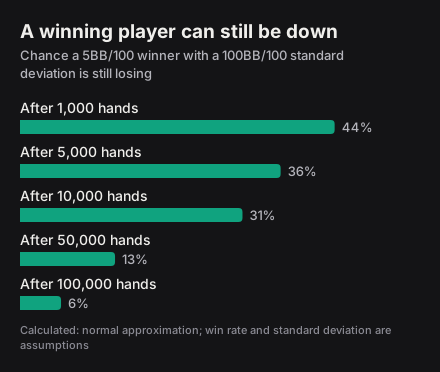
(Calculated with a normal approximation, not user data.)
Another way to look at poker variance: over 1,000 hands, the same winner will land somewhere between down 5.7 buy-ins and up 6.7 buy-ins 95% of the time. Over 10,000 hands, the range is down 14.6 to up 24.6 buy-ins.
So losing 5 buy-ins over 1,000 hands can easily be nothing but luck. The flip side: winning 5 buy-ins over 1,000 hands doesn't prove you're playing well either. With too few hands, results tell you almost nothing.
What to do during a downswing
- Judge decisions, not results: pull out the most painful hands and sort them into two piles, "misplayed" and "played right but lost." Fix the first pile and accept the second.
- Check your all-in EV: most tracking software can show all-in adjusted winnings (all-in EV). If your actual results sit well below that line, you've been unlucky in all-ins. If both lines are heading down together, the problem is more likely your play.
- Set a stop-loss and a time limit: 26% of players asked how long to play in one session and when to stop. Deciding in advance, for example "leave after losing 3 buy-ins" or "take a break after 2 hours," is more reliable than deciding after you've lost.
- Moving down isn't failure: dropping a level during a losing streak lets the same bankroll survive bigger swings. See "Bankroll Management: The Survival Guide Every Poker Player Needs".
- If you suspect rigging, look at the sample first: most major sites publish third-party certification of their shuffle's randomness. Rather than doubting the site, it's more reliable to build up enough hands and see how far your actual all-in results are from your expected value.
Let the AI tell luck apart from your play
The hardest part after a loss is calmly working out whether you actually misplayed the hand. Give your hands to DEEPFOLD and the AI coach will review them street by street, showing which decisions were mistakes and which hands were just coolers. DEEPFOLD can read GGPoker hand histories, X-Poker replay links or screenshots directly. Try it free.
Frequently Asked Questions
How long is a normal poker downswing?
Take a winner at 5BB per 100 hands with a standard deviation of 100BB: after 1,000 hands they still have a 44% chance of being down, and after 10,000 hands a 31% chance. Losing 5 buy-ins over 1,000 hands, or even a dozen or so buy-ins over 10,000 hands, can be nothing more than normal variance for a winning player.
How can I tell bad luck from bad play?
Judge decisions, not results. Review your losing key hands one by one and sort them into misplayed and played right but lost. Then check all-in EV in your tracking software: if your actual results are well below your expected value, you've been unlucky in all-ins, and if both are heading down together, the problem is more likely your play. Of the 5,614 key hands the AI reviewed, only 1% were judged pure luck.
Is online poker rigged?
In DEEPFOLD's data, only 8% of players who talked about the mental game ever suspected the deal was rigged. Most major sites publish third-party certification of their randomness. Rather than doubting the site, a more reliable check is to build up enough hands and compare your actual all-in results with your expected value.
Where does this data come from?
From 667 messages about the mental game that 66 players sent the DEEPFOLD AI coach between February and October 2026, plus 5,614 key hands uploaded by 354 players over the same period and reviewed hand by hand by the AI. All numbers are anonymized aggregates, ranked by the share of players who talked about each topic.
Methodology and limitations
- Data: from DEEPFOLD chat coach messages between February and October 2026, we took messages mainly about downswings, luck, tilt, pressure or motivation (excluding follow-ups, product questions and small talk). That gave 667 messages from 66 players. A language model then tagged each message's main topic, how the player explained the loss, and any loss amount and hand count mentioned, with manual spot checks. The messages were spread across languages: about half were in English, Dutch and other European languages, and the rest were mostly Chinese and Korean.
- How we counted: topic rankings use the share of players who talked about each topic. This data is very concentrated: the single most active player sent about 29% of the messages and the top 5 sent about 61%, so we don't rank by message count. Excluding the top 5 players, the order and shares of the top 6 topics stay similar, and the share of messages blaming luck (59%) is about the same.
- Limitations: loss explanations only count the 49 players who gave a reason. Hand counts and loss amounts were stated by only 14 and 16 players, so they show direction only. The AI verdicts come from key hands uploaded by a different group of players. The AI prioritizes big pots and judges strictly, so the cooler share may be underestimated. The winner's losing-chance table uses a normal approximation, and the win rate and standard deviation are assumptions, not user data.
- Privacy: all numbers are anonymized aggregates. Examples in the text are paraphrased and don't quote any player's actual words.